Aloo Biryani
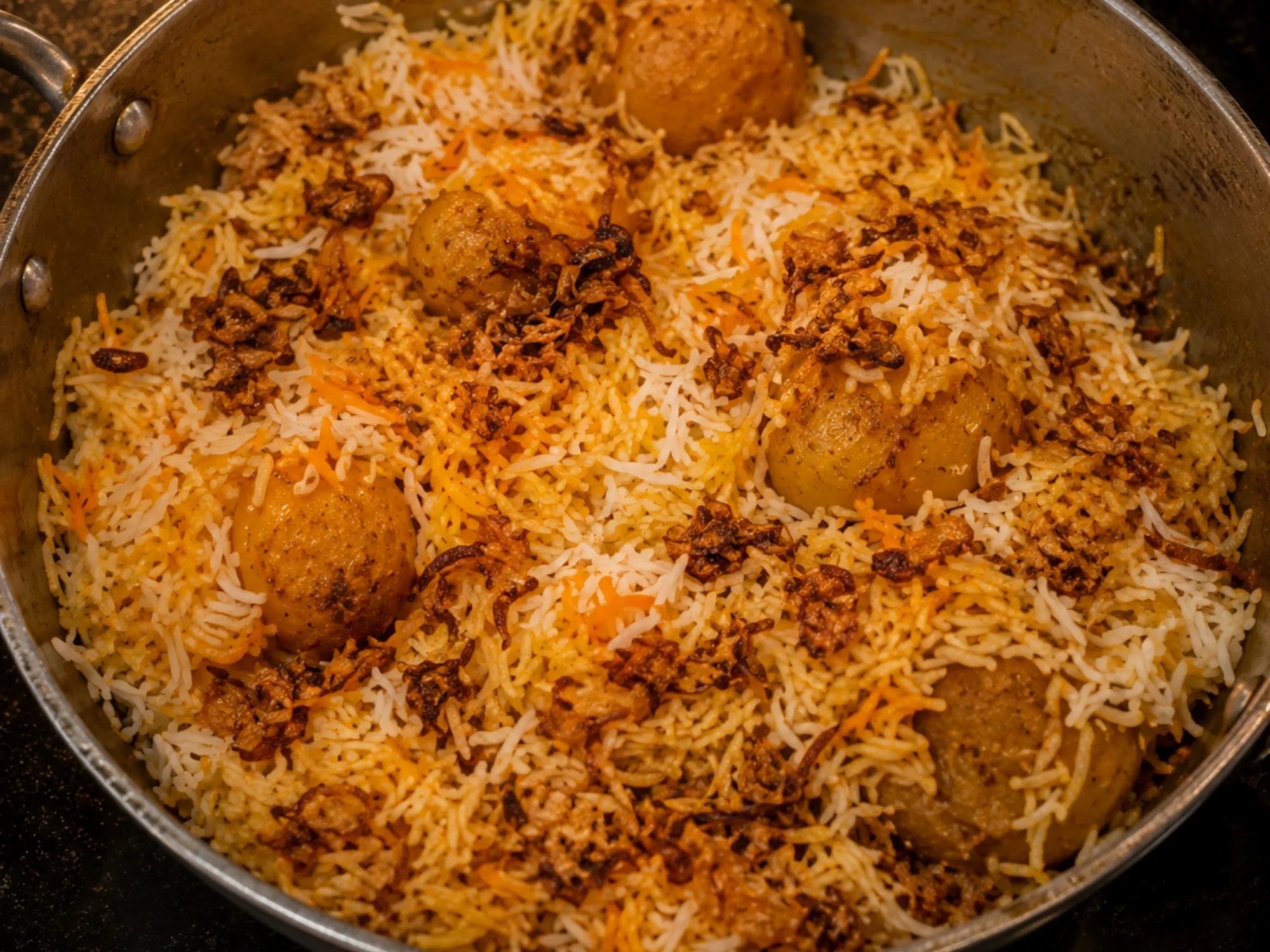
Potatoes browned in ghee, marinated in spiced curd, then layered under parboiled rice and steamed shut so they finish soft inside a crisp skin.
Drafted — not yet cooked in our kitchen
- Hands on
- 26 min
- Total
- 1 hr 58 min
- Serves
- 4
- Difficulty
- hard
The trick is that the potatoes go into the pot raw in the middle. Brown them hard for the skin, then let the sealed steam finish them in the marinade, and they come out soft and saturated instead of boiled and bland.
Step by step, with timers and flame levels. Your screen stays awake.
Ingredients
Tap what you already have.
Method
Rinse the rice gently until the water loses its milkiness — four or five changes. Handle it lightly; basmati is brittle dry and broken grains are what make a biryani sticky. Cover with water and leave. Drain it fifteen minutes before you boil it.
Look for: A grain should break in two under a fingernail rather than bend. Longer than 45 minutes and it begins to go fragile.
30–45 min · bowl
Heat the oil in a kadai on medium-high and fry the sliced onion in two batches. Keep them moving once they start colouring — they go from gold to bitter in under a minute. Lift them out onto a plate lined with paper while they are still a shade lighter than you want, because they darken off the heat. Keep the flavoured oil; it goes into the potatoes next.
Look for: The furious bubbling settles down, the slices shrink to about a third and turn an even reddish brown. On the paper they should crisp as they cool — if they stay limp, they came out too early.
10–15 min · medium-high heat · kadai
In the same oil, on medium-high, brown the potatoes. Halve small potatoes and quarter large ones, but leave them in big pieces — they have to survive being layered. Turn them so they colour on all cut faces. They will still be raw in the middle; that is correct, they finish in the dum.
Look for: A firm golden-brown skin on the cut faces, and a skewer meets clear resistance at the centre. Soft all the way through here means mash by the end.
8–12 min · medium-high heat · kadai
Whisk the curd smooth in a wide bowl, then stir in the ginger-garlic paste, the ground spices, the slit green chillies, the mint and coriander, half the fried onion and the salt. Fold the hot fried potatoes through it and leave them. The curd has to be at room temperature or it will split against the hot potatoes.
Look for: The marinade should coat the potatoes in a thick orange film that does not run off when you tilt the bowl. If it looks watery, the curd was thin — hang it in a cloth for ten minutes and start again.
20–30 min · bowl
Warm the milk barely to blood heat, crush the saffron between your fingers into it, and leave it to bloom while the rice boils.
Look for: The milk turns deep orange-gold and smells of saffron across the room. Hot milk scalds the threads and gives you colour without scent.
10–15 min · bowl
Bring a large pot of water to a rolling boil with the whole spices and enough salt that it tastes like a well-seasoned soup. Tip in the drained rice and boil it uncovered on high. You are looking for seventy per cent cooked, not done — start testing at four minutes and do not walk away.
Look for: Crush a grain between your fingers: it should flatten at both ends and leave a distinct hard white line down the middle. It should still fight you slightly when you bite it. Drain it the second it gets there — the residual heat carries it further.
4–7 min · high heat · stockpot
Use a heavy pan with a lid. Spread the marinated potatoes and every drop of the marinade across the base in one even layer, then dot the ghee over them. Pile the drained rice on top without pressing it down. Scatter the remaining fried onion, mint and coriander, then trickle the saffron milk over in lines rather than in one puddle, so you get both white and gold grains.
Look for: The rice sits loose and mounded, not packed. You should be able to see the marinade at the sides of the pan but no free liquid pooling above the potatoes.
4–6 min · kadai
Seal the pan — a sheet of foil crimped over the rim under the lid, or a rope of chapati dough pressed around it. Cook on high for the first three minutes to get the steam started, then set the pan on a tawa over the lowest possible flame for the rest. The tawa is not optional on a home burner; direct low flame still scorches the potatoes at the centre.
Look for: Steam pushing at the seal, and the smell changing from raw rice to biryani about fifteen minutes in. Tap the lid and it should feel hot to a fingertip all across. Do not open it to check.
22–28 min · low heat · kadai
Take the pan off the heat and leave it sealed. This rest is part of the cooking, not a pause before serving — the grains firm up and stop sticking to each other.
Look for: The pan is still hot but no longer hissing at the seal.
10–15 min · kadai
Open it, and take it out with a flat spatula from one side, going right down to the base each time so every plate gets potato, masala and both colours of rice. Never stir a biryani round in the pan. Serve with a raita and a wedge of lemon.
About this dish
Aloo biryani is what a Hyderabadi kacchi dum is once you take the meat out and let the potato do that job properly: big pieces, browned hard, marinated in curd, and cooked through only in the sealed pot. It is not vegetable biryani with the vegetables reduced to potato — a mixed-vegetable biryani has to be cooked separately and layered, because carrots and beans and potatoes never finish together. Potato variety matters more than it looks. A waxy potato holds its shape and gives you neat pieces; a floury one drinks the marinade and turns creamy at the edges. Both are good, and they are genuinely different dishes — pick on purpose rather than by what is in the basket. If you want it hotter, add slit green chillies to the layer rather than more chilli powder. Powder past a point just makes it blunt.