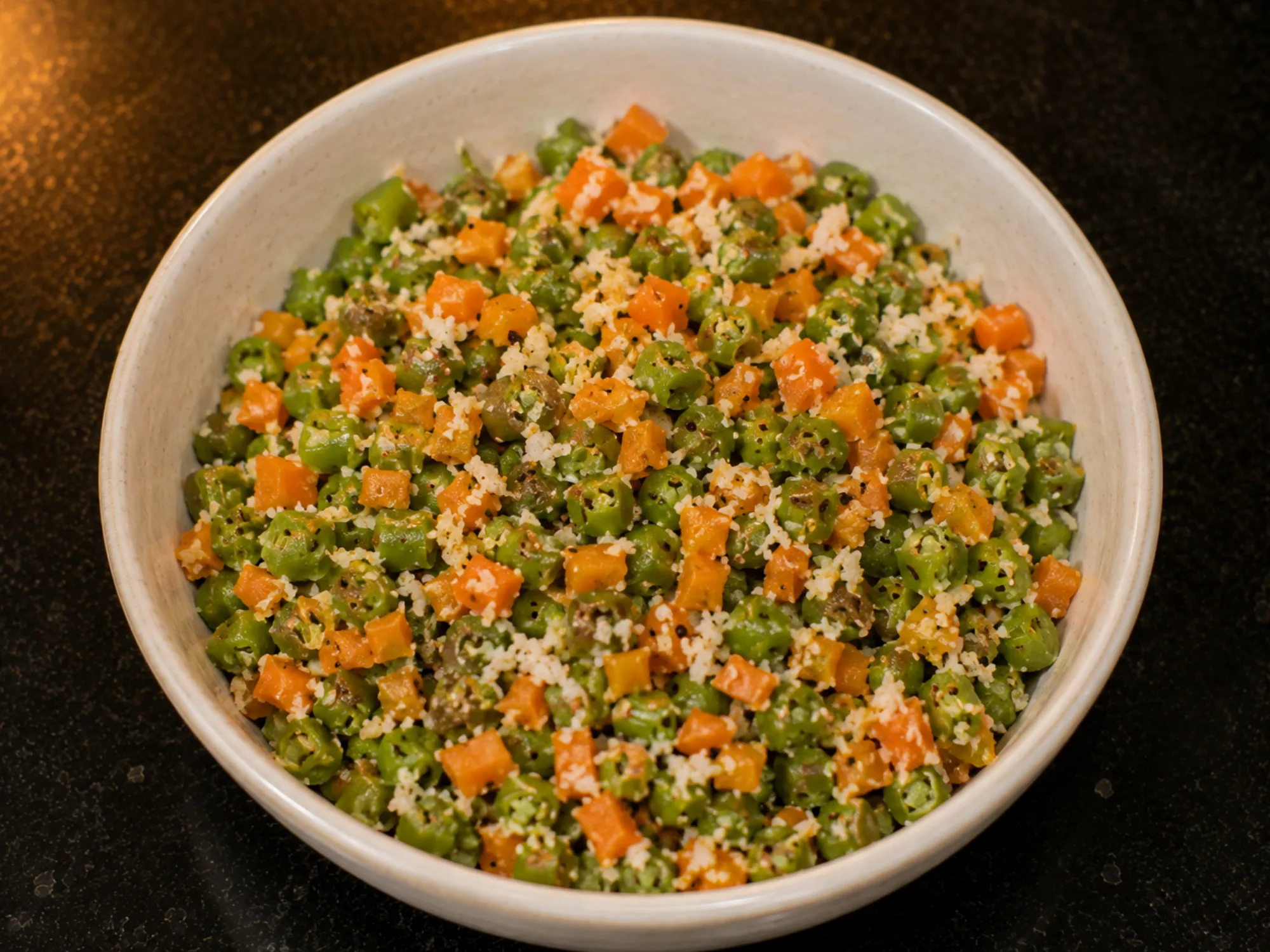
Beans and Carrot Poriyal
French beans and carrot cooked in their own steam and finished with fresh coconut — a dry vegetable side in fifteen minutes.
Drafted — not yet cooked in our kitchen
- Hands on
- 20 min
- Total
- 20 min
- Serves
- 4
- Difficulty
- easy
Fifteen minutes, one pan, and the only judgement call is when to stop cooking the beans. They should still have some snap when the coconut goes in.
Step by step, with timers and flame levels. Your screen stays awake.
Ingredients
Tap what you already have.
Method
Cut the beans and carrot to the same small dice — about the size of a pea. In a poriyal the two vegetables have to finish together, and beans take longer than carrot, so the beans go smaller than feels natural.
Look for: Two piles of roughly matched dice. Nothing bigger than a pea.
10–15 min
Heat the coconut oil in a kadai over medium and add the mustard seeds. Once they have popped, add the urad dal, then the broken chilli, the asafoetida and the curry leaves. Urad dal in a tempering is textural as much as anything — it stays crunchy in the finished dish.
Look for: Mustard finished popping, urad dal gone honey-coloured, curry leaves stiff. The chilli should smell warm, not acrid — if it darkens fast, lift the pan off.
2–3 min · medium heat · kadai
Add the vegetables and the turmeric and toss them through the tempering over medium for a minute or two, so everything takes on a film of oil before any water goes near it.
Look for: The beans have gone a brighter green and everything is evenly yellow.
1–2 min · medium heat · kadai
Sprinkle in a few tablespoons of water and the salt, cover, and lower the heat. The vegetables cook in their own steam from here — this is not a braise, and the pan should never have standing water in it.
Look for: A bean gives under a fingernail but still snaps rather than bending — cooked through with the squeak gone, well short of soft. Lift the lid at six minutes and check; overcooked poriyal goes khaki and cannot be undone.
6–9 min · medium-low heat · kadai
Take the lid off and turn the heat up for a moment to drive off whatever water is left in the pan. A wet poriyal will not hold the coconut.
Look for: The pan base is dry and the vegetables sizzle rather than hiss when stirred.
1–2 min · medium-high heat · kadai
Off the heat, fold in the grated coconut. It goes in with the pan off — coconut cooked in the pan browns and goes chewy, and what you want here is the raw sweetness against the mustard.
· kadai
About this dish
Poriyal is a method more than a recipe. Almost any firm vegetable cut small takes the same treatment — cabbage, beetroot, snake gourd, cluster beans, ash gourd — and the only things that change are the cooking time and whether it needs a splash of water at all. Cabbage needs none; beetroot needs a lid and twice as long. The equivalent dish is called palya in Karnataka and thoran in Kerala, and the Kerala version usually grinds the coconut with cumin and garlic rather than scattering it in raw at the end. For a child this is the mildest way to get a green vegetable eaten: the coconut sweetens it, the pieces are small enough not to be picked out, and the single dried chilli is there for aroma rather than heat.