Idiyappam
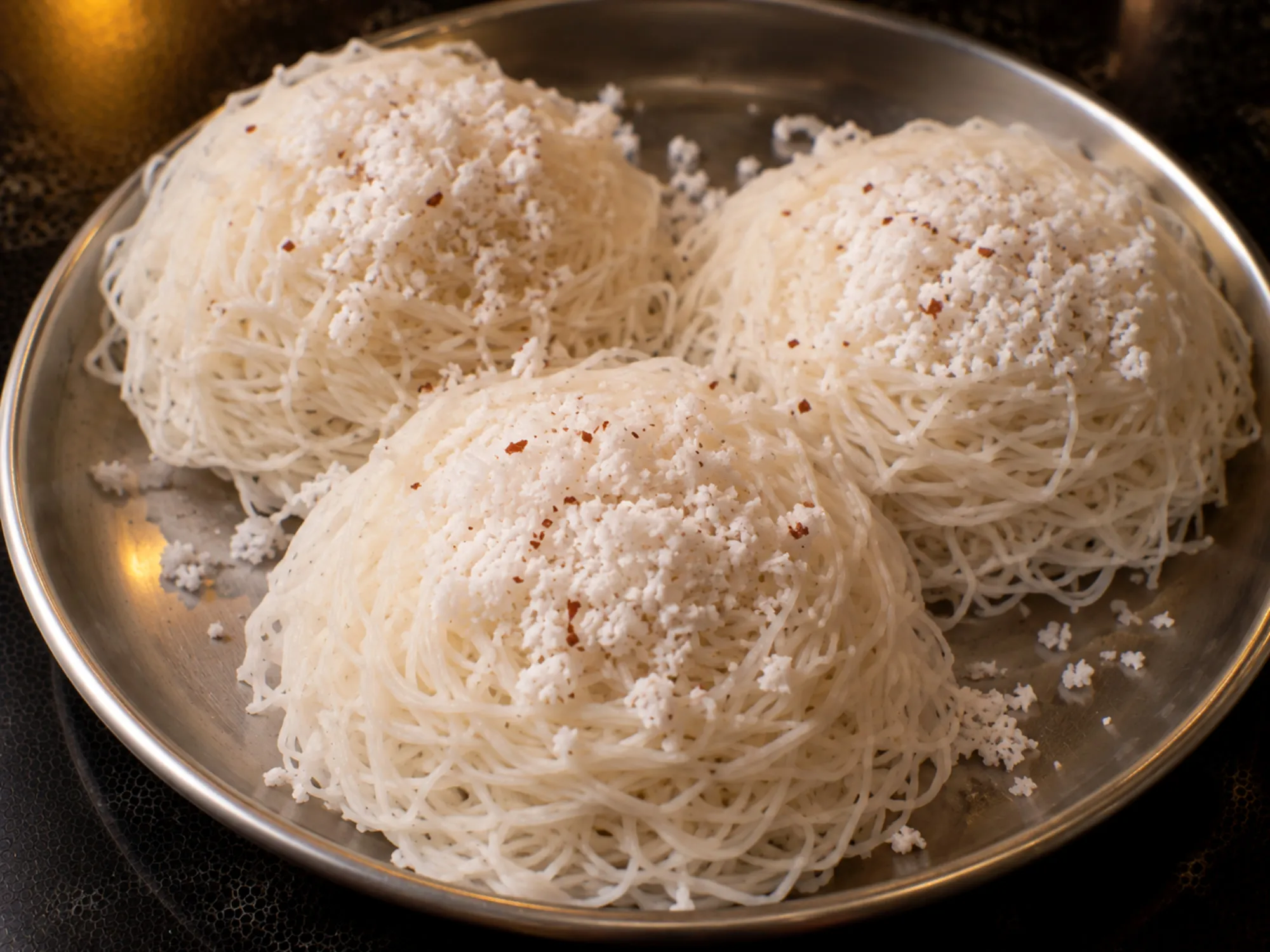
Kerala's steamed rice string hoppers — soft white threads pressed over grated coconut, eaten with a thin curry or sweetened milk.
Drafted — not yet cooked in our kitchen
- Hands on
- 20 min
- Total
- 28 min
- Serves
- 4
- Difficulty
- medium
Idiyappam lives or dies on the dough, and the dough lives or dies on boiling water. Hot-from-the-tap water gives you something that looks right in the bowl and then jams in the press. Get the water properly boiling, keep the dough covered while you work, and the rest of it is just squeezing.
Step by step, with timers and flame levels. Your screen stays awake.
Ingredients
Tap what you already have.
Method
Dry-roast the rice flour in a heavy kadai on low, stirring constantly so nothing sits on the base. You are driving off raw smell and moisture, not colouring it.
Look for: The flour turns loose and free-flowing instead of packing under the spoon, and smells faintly toasted. It should stay white — any beige and you have gone too far.
4–6 min · low heat · kadai
Bring the water and salt to a hard boil in a saucepan. It has to be boiling, not hot, or the dough will never come together.
Look for: A rolling boil that keeps moving when you stir it, not a rim of small bubbles.
3–5 min · high heat · saucepan
Tip the hot flour into a wide bowl and pour in the boiling water in three or four goes, mixing with the handle of a wooden spoon after each. Once it stops steaming enough to handle, knead with your palm until smooth. Keep the last 50 ml back until you see how the dough behaves.
Look for: Soft and smooth, like a firm chapati dough but stickier. Press a thumb in — it holds the dent and the edges do not crack. If it crumbles, add hot water a tablespoon at a time; if it sticks to your palm in strings, dust in a little dry flour.
3–5 min · bowl
Grease the idli plates and the inside of the idiyappam press with coconut oil, and scatter a pinch of grated coconut over each mould. Keep the dough covered with a wet cloth while you work — it dries out fast and then it will not extrude.
2–3 min
Fill the press with a lump of warm dough and squeeze it over the plates in a flat spiral, starting at the centre. One layer, roughly the size of your palm. Do not build them tall — a thick nest steams unevenly and stays raw in the middle.
Look for: The threads should come out continuous and even. If they break into short pieces the dough is too dry; if they collapse into a puddle it is too wet.
8–12 min
Stack the plates in the steamer over water that is already boiling, cover, and steam on medium-high.
Look for: The threads go from chalky white to a matte, faintly translucent white, and the raw-flour smell is gone. Touch one — it should feel dry-springy and lift without gumming onto your finger.
6–8 min · medium-high heat · idli steamer
Take the plates out and leave them uncovered for a couple of minutes before lifting the idiyappams off. Straight out of the steamer they tear; a short rest sets them.
Look for: The surface loses its wet sheen and the nest lifts off the plate in one piece.
2–3 min
About this dish
Idiyappam is eaten across Kerala and in Tamil Nadu, where it is usually called string hoppers or sevai depending on how it is made. In Kerala it is a breakfast dish, most often with kadala curry, a thin vegetable stew, or simply coconut milk sweetened with a little jaggery. The press is the one piece of equipment there is no real way around. A potato ricer with a fine plate does the same job; a piping bag does not — the threads come out too thick and steam into noodles rather than lace.